

When buyers compare homes, the first number they usually look at is the price.
$500,000 house. $450,000 house. $400,000 house.
But unless you’re paying cash, that’s not really the number you’re going to feel every month.
Your actual housing payment is generally mortgage principal + interest + property taxes + homeowners insurance, plus HOA fees when applicable.
And when you’re comparing Illinois with Northwest Indiana, property taxes can make two similarly priced homes feel very different once the mortgage statement arrives.
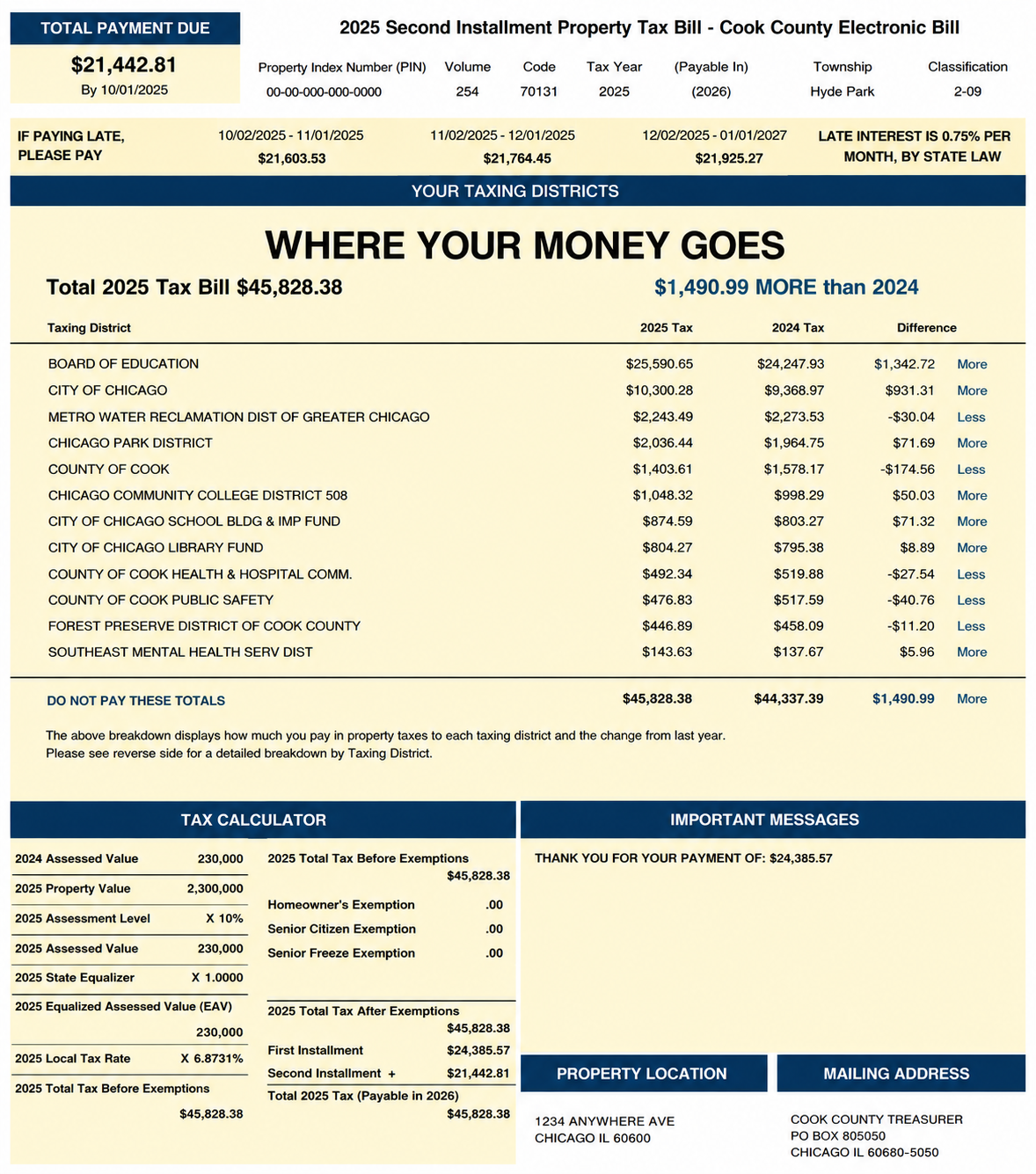
Property Taxes: Look at the Bill, Not Just the Price
Illinois property taxes vary substantially by municipality, school district and individual property. Even within Naperville, for example, the total tax rate can differ depending on the taxing districts serving a particular address.
Illinois also doesn’t have a simple rule that caps an individual homeowner’s property-tax bill at a fixed percentage of the home’s value. The state’s PTELL system limits certain taxing districts’ overall tax extensions, not an individual property’s tax bill.
Indiana works differently.
For a primary residence (homestead), Indiana generally limits property taxes to about 1% of the home’s assessed value. Investment properties are higher, and other categories can go up to 2% or 3%.
That 1% homestead cap is a big reason Illinois buyers often notice a sharp difference when they first compare Indiana tax bills.
Munster Isn’t “Low Tax”—But the Cap Matters
There’s an important distinction here.
Munster’s 2026 certified gross tax rate is 2.8261%. Dyer’s is 2.5288%, while Schererville’s is 1.9870%.
So how does the 1% cap work if the tax rates are higher than 1%?
Because in Indiana, the tax rate is not the final number you pay. The homestead cap and deductions work together to limit what actually comes out of your pocket.
In simple terms: the system calculates a tax amount, then the cap helps reduce it for qualifying homeowners.
That’s why I always tell buyers: don’t guess—look at the actual tax bill for the specific house.
Monthly Payment: This Is Where It Gets Interesting
Imagine you’re comparing two homes with similar purchase prices—one in suburban Illinois and one in Northwest Indiana.
Even if the mortgage amount and interest rate are identical, a difference of $6,000 per year in property taxes equals $500 per month.
That’s real money.
It may be the difference between comfortably affording a home and feeling house-poor every month. Or it could allow a buyer to spend somewhat more on the Indiana house while keeping the overall monthly payment similar.
This is why asking “How much house can I afford?” isn’t quite the right question.
A better question is:
“What total monthly housing payment am I comfortable with?”
Then work backward.
Illinois vs. Indiana: Don’t Oversimplify It
This doesn’t mean every Indiana house is automatically cheaper to own.
Home prices in Munster, Dyer and other desirable Northwest Indiana communities have risen substantially. Insurance varies. HOA fees vary. Commuting from Indiana to Illinois has a cost too—and your car unfortunately does not accept property-tax savings as gasoline.
For cross-border buyers, compare the whole package:
- Purchase price and mortgage payment
- Actual property-tax bill
- Homeowners insurance and HOA
- Commute and transportation costs
- Expected maintenance
One house might cost $30,000 more but still have the lower monthly carrying cost.
Before You Make an Offer, Check the Taxes
One last caution: don’t assume the seller’s current tax bill will automatically become yours.
Exemptions, deductions, reassessments and changes in ownership can affect future taxes. This is especially important when you’re comparing properties across state lines, where the systems work differently.
Before making an offer, look up the property’s actual tax history and ask your lender to build the taxes into your estimated monthly payment.
Because ultimately, you don’t live in the purchase price.
You shop the price, but you live the monthly payment.